
Description
ABB UNITROL 1020 (Brushless) – Digital AVR for stable excitation control on brushless generators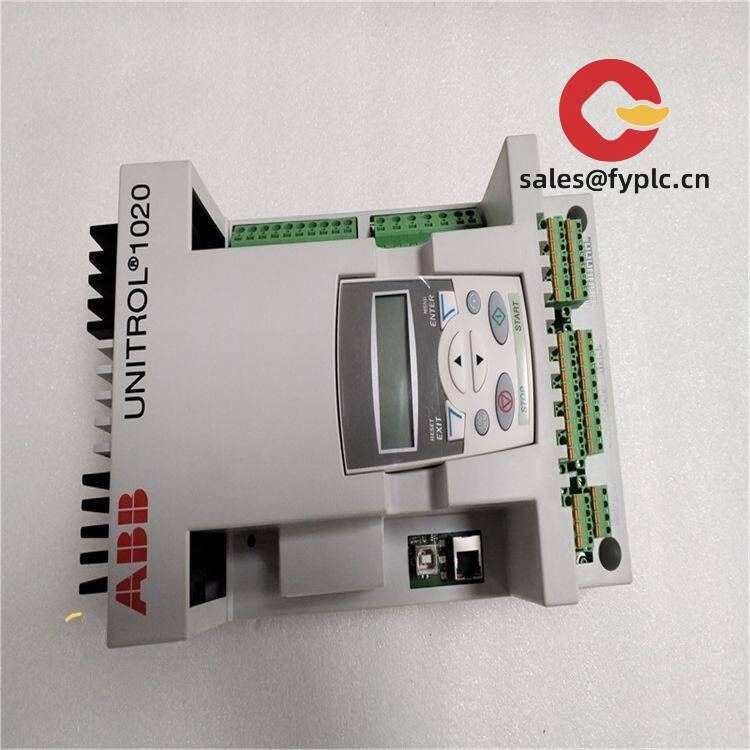
If you’re upgrading a brushless genset or standardizing a fleet of medium-size synchronous machines, ABB UNITROL 1020 typically hits the sweet spot. It’s a compact, digital automatic voltage regulator designed for brushless exciters, giving you fast voltage response, robust limiters, and easy field tuning. From my experience, it’s a go-to when you want reliable VAR/PF control, predictable grid support, and fewer surprises during commissioning.
Company’s Order Placement Process and Guarantees
- Warranty: 365 days from delivery
- Delivery: 1 week if in stock; no more than 1 month at the latest
- Payment: 50% advance payment; full payment prior to delivery
- Express options: FedEx, UPS, DHL
Key Features
- Digital AVR for brushless exciters – Stable voltage control and fast transient response for synchronous generators using rotating diode wheels.
- Multiple control modes – Voltage, VAR, or power factor control; smooth switching helps during parallel operation.
- Integrated limiters and protection – Under/over-excitation limiters, V/Hz limiter, and typical generator safeguard functions to keep the machine inside safe operating areas.
- Proven grid support – Adjustable droop, reactive power sharing, and PSS-style damping functions that help with grid code compliance in many cases.
- Flexible I/O – 1- or 3-phase voltage sensing with a mix of analog inputs and digital/relay outputs for interlocks and supervision.
- Industrial communications – RS‑485 Modbus RTU as standard in many setups; optional fieldbus (such as Profibus DP or CANopen) is commonly available for fleet integration.
- Commissioning-friendly – PC-based parameterization, trend viewing, and event logs speed up tuning and fault finding.
- Compact, cabinet-ready form – Designed for panel/backplate mounting; neat wiring and clear terminal layout help reduce installation time.
Technical Specifications
| Brand / Model | ABB UNITROL 1020 (Brushless AVR) |
| HS Code | 9032.89 (Automatic regulating or controlling instruments; other) |
| Power Requirements | 24 V DC nominal (typical industry practice) |
| Operating Temperature | Typically −20°C to +55°C (cabinet installation recommended) |
| Signal Input/Output Types | 1- or 3-phase voltage sensing; analog inputs for references; digital inputs; relay/alarm outputs; field control output for brushless exciter |
| Communication Interfaces | RS‑485 (Modbus RTU); optional Profibus DP / CANopen (depending on configuration) |
| Installation Method | Panel/backplate mounting inside control cabinet; DIN‑rail adapter available in many setups |
Note: Exact interface options and environmental limits may vary by sub-variant and option cards. For critical design decisions, it appears best to confirm the final I/O and field rating from your machine data and the ABB datasheet.
Application Fields
- Genset manufacturers and packagers – Standardize excitation across 400 kW–multi‑MW brushless machines to simplify service and spare parts.
- Independent power producers & industrial plants – Voltage and VAR control for cogeneration/CHP, cement, mining, and paper mills, typically with parallel operation.
- Marine & offshore – Stable PF control for auxiliary and propulsion generators, where fast load changes are common.
- Data centers & hospitals – Consistent voltage regulation under step loads for backup generators.
- Small hydro and renewables hybrids – Reactive power support and damping functions that help with grid interaction.
Advantages & Value
- Reliability – Solid-state design with proven protective limiters reduces nuisance trips and keeps the generator within capability curves.
- Compatibility – Designed for brushless exciters; integrates smoothly with standard PT/VT sensing and common governor/PLC architectures.
- Commissioning speed – Parameter templates and live trending typically cut tuning time and help teams hit reactive sharing targets faster.
- Lifecycle savings – Fewer moving parts than older analog AVRs, remote diagnostics, and flexible comms lower maintenance and integration costs.
- Fleet integration – Modbus and optional fieldbus modules make SCADA/PLC connectivity straightforward.
You might notice that once voltage and droop are dialed in, parallel operation becomes very predictable. One customer in a marine yard mentioned they moved from weekly adjustments to quarterly checks because the sharing stayed inside ±2% most of the time.
Installation & Maintenance
- Cabinet & environment – Mount inside a clean, dry control cabinet (IP54 or better in harsh areas). Provide ventilation to keep the controller within its rated temperature.
- Wiring – Use shielded twisted pairs for sensing and communications. Land PT/VT sensing per ABB polarity marks. Keep power and signal wiring segregated to reduce EMI.
- Grounding – Bond the controller reference to the cabinet ground bar; ensure a single-point reference to avoid loops.
- Commissioning – Start with conservative gain settings; verify UEL/OEL and V/Hz limiter setpoints against the generator capability curve. Validate droop and PF mode in both island and parallel operation.
- Routine checks – Quarterly visual inspection for loose terminals, annual parameter backup and firmware review, and cleaning with dry air. Re-verify alarms/trips after major maintenance.
Quality & Certifications
- Compliance: CE marking; RoHS-conforming design for electronics in most variants
- Manufacturing: Produced under ISO 9001 quality systems
- Warranty: 12 months (365 days) standard from delivery
Tip: If you’re replacing an older AVR, send the existing PT ratios, exciter field data, and desired control mode (Voltage/VAR/PF). It seems to speed up parameterization and ensures the UNITROL 1020 ships with the right option set.

Reviews
There are no reviews yet.