
Description
National Instruments NI SCXI-1520 – 8‑Channel Strain/Bridge Input Module for Precision Measurements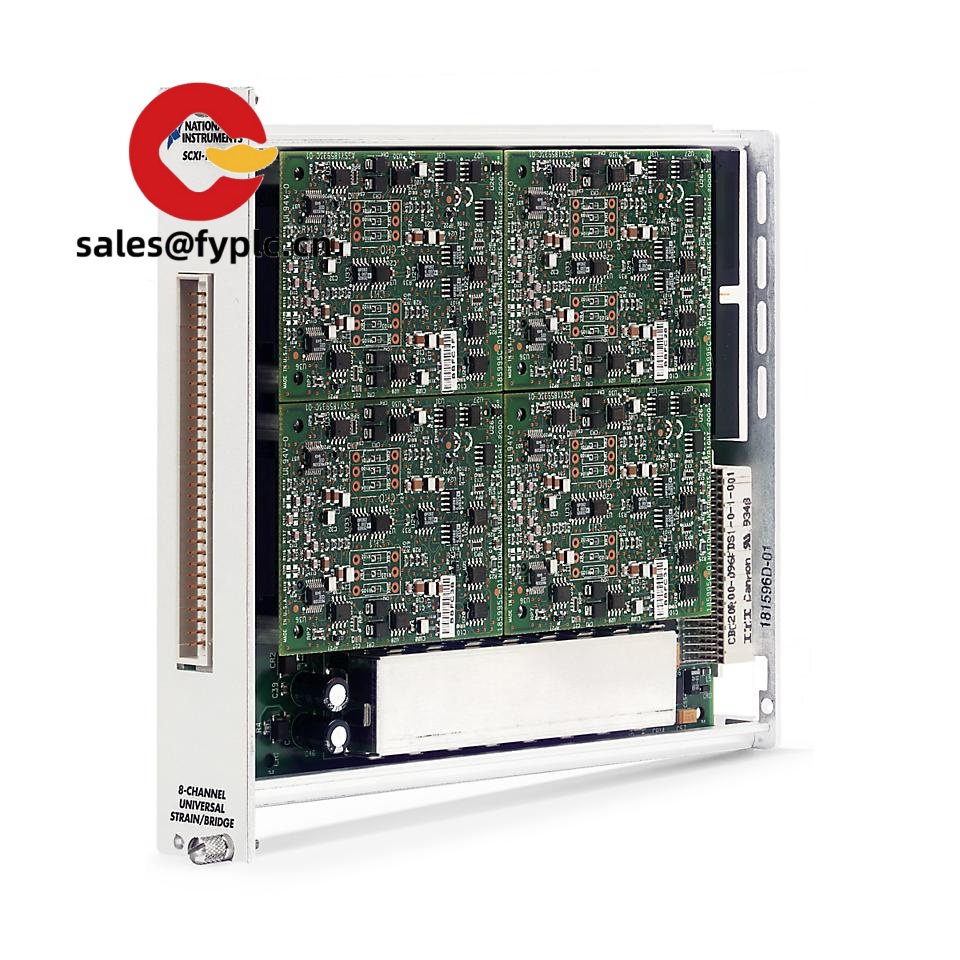
The NI SCXI-1520 is a dedicated 8‑channel strain/bridge input module for SCXI systems. It’s built for quarter-, half-, and full-bridge sensors—think strain gauges, load cells, pressure transducers—where signal stability and clean low‑level measurement really matter. From my experience, teams choose the SCXI-1520 when they need reliable bridge completion, shunt calibration support, and programmable conditioning in one tidy module that ties straight into an NI DAQ device through the SCXI chassis.
Order Placement Process & Guarantees
- Warranty: 365 days
- Delivery time: Typically 1 week if in stock; no more than one month at the latest
- Payment terms: 50% advance payment; full payment prior to delivery
- Express options: FedEx, UPS, DHL
Key Features
- 8 strain/bridge channels: Designed for quarter-, half-, and full-bridge sensors used in structural, fatigue, and load testing.
- Software-configurable conditioning: Programmable instrumentation amplifier gain and per‑channel lowpass filtering help maximize SNR on low‑level signals.
- Bridge completion via terminal block: Works with SCXI‑1314/SCXI‑1314T terminal blocks for built‑in completion resistors and shunt calibration—saves wiring time.
- SCXI chassis integration: Connects through the SCXI backplane to NI DAQ devices (PCI/PXI/USB via SCXI interface), so you can scale channels without re‑architecting the system.
- Stable, low‑noise design: You might notice that drift and thermal effects are well controlled in typical lab and production environments.
- Field-proven for multi-sensor setups: In many cases, users run mixed bridge types across the 8 channels with consistent calibration behavior.
Technical Specifications
| Brand / Model | National Instruments NI SCXI-1520 |
|---|---|
| HS Code | 9030.89 (Measuring/checking instruments; commonly used for DAQ/conditioners; subject to local customs) |
| Channels | 8 strain/bridge input channels (differential) |
| Supported Bridge Types | Quarter, Half, Full (typical 120 Ω / 350 Ω gauges via SCXI‑1314/1314T) |
| Signal Input/Output Types | 8 differential analog inputs; bridge completion and shunt calibration via terminal block; per‑channel filtering |
| Programmable Conditioning | Software‑selectable gain and lowpass filter settings (per channel) |
| Communication Interfaces | Via SCXI backplane to NI DAQ devices (e.g., through SCXI‑1349 to PCI/PXI DAQ, or SCXI‑1600 for USB control) |
| Power Requirements | Powered from SCXI chassis backplane (no external supply) |
| Installation Method | Single‑slot SCXI module; installs in SCXI‑1000/1001/1000DC chassis; front connector mates with SCXI‑1314/1314T terminal blocks |
| Operating Temperature | 0 °C to 50 °C (typical for SCXI modules) |
| Dimensions & Weight | Standard single‑slot SCXI form factor |
Related or Supporting Products
- SCXI‑1314 / SCXI‑1314T Terminal Blocks: Bridge completion, shunt calibration, and screw‑terminal wiring for the SCXI‑1520. The “T” version typically offers better thermal tracking.
- SCXI‑1000 / SCXI‑1001 / SCXI‑1000DC Chassis: Houses SCXI modules; choose slot count and AC/DC power per site requirements.
- SCXI‑1349 Interface: Connects the SCXI chassis to PCI/PXI DAQ boards—common in legacy setups that still need dependable throughput.
- SCXI‑1600 USB Controller: For users who prefer direct USB control of the SCXI chassis without a separate PCI/PXI DAQ card.
- NI 9237 (cDAQ) – Alternative: 4‑channel bridge module for cDAQ platforms; a modern option when you don’t require a full SCXI rack.
- NI PXIe‑4330 Series – Alternative: High‑accuracy bridge input modules for PXI Express; suitable when higher sample rates or tighter synchronization are needed.
Installation & Maintenance
One thing I appreciate is how straightforward wiring becomes with the correct terminal block. Typically, you’ll mount the SCXI‑1520 in an SCXI chassis (leave at least 50 mm of clearance for airflow), then attach the SCXI‑1314/1314T and land your gauges with shielded twisted‑pair. Keep your excitation and sense leads paired and tightly routed to minimize thermal EMFs.
- Cabinet & ventilation: Install the chassis in a clean, dry rack with front‑to‑back airflow. Avoid mounting near high‑power drives or relays that inject EMI.
- Grounding & shielding: Bond the chassis to a single‑point ground. Tie cable shields to the terminal block end; in many cases, floating the sensor end reduces ground loops.
- Wiring best practices: For quarter‑bridge, match completion resistor to gauge resistance (commonly 120 Ω or 350 Ω). Use the terminal block’s shunt cal to verify wiring and gauge health.
- Software setup: Configure gain and filter settings per channel in NI‑DAQmx. You might notice that a slightly lower cutoff often improves repeatability on slowly varying loads.
- Routine maintenance: Annual calibration is typical. Inspect screw terminals periodically; re‑torque if needed. Keep terminals clean and dry; replace worn cables and strain‑reliefs.
- Firmware/driver notes: Use current NI‑DAQmx drivers supported by your OS and SCXI interface; updates often improve stability.
- Safety: Sensor circuits are low voltage; still, power down the chassis before changing wiring, and avoid running gauge leads alongside mains cables.
A quick field note from a customer: switching from ad‑hoc bridge conditioning to the SCXI‑1520 with SCXI‑1314 cut their channel‑to‑channel variability by about 20% during thermal cycling, mostly thanks to consistent completion and filtering.
Quality & Certifications
- Certifications (typical): CE compliant; RoHS compliance depending on hardware revision; manufactured under ISO 9001 quality systems. UL or CB scheme may apply at the chassis level.
- Warranty: 365‑day warranty provided with supply.
- Traceability: Calibration traceability available through NI or accredited labs on request.
Notes: Specifications can vary slightly by hardware revision and terminal block selection. For customs, HS code 9030.89 is commonly used for signal‑conditioning/DAQ modules; confirm with your broker for the destination country.





Reviews
There are no reviews yet.