
Description
ABB REF601 Feeder Protection Relay – Reliable overcurrent and earth-fault protection for MV distribution feeders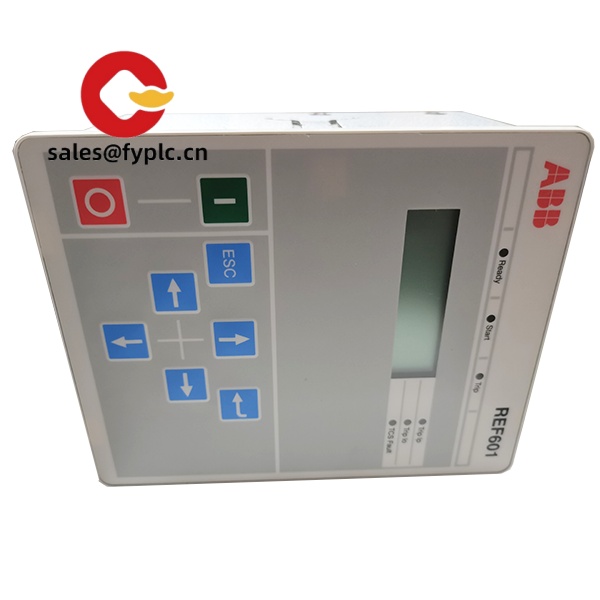
The ABB REF601 is a compact numeric feeder protection relay designed for medium-voltage distribution feeders in secondary substations and industrial switchgear. It focuses on non-directional overcurrent and earth-fault protection, trip logic, basic control, and status indication. From my experience, it’s a solid choice when you want dependable protection without the complexity of a full substation IED platform. You might notice that it fits particularly well in ring-main units and compact switchgear where space and simplicity matter.
Our Order Placement Process and Guarantees
- Warranty: 365 days from delivery
- Delivery: 1 week if in stock; no more than 1 month latest
- Payment: 50% advance payment; full payment before delivery
- Express options: FedEx, UPS, DHL
- Order support: technical cross-check of part codes and I/O needs before we ship
Key Features
- Non-directional overcurrent (50/51) and earth-fault (50N/51N) – Core protection for MV feeders, typically set up with separate definite/IDMT curves.
- Selectable CT inputs (1 A / 5 A) – Suits existing CT circuits; minimizes retrofit work.
- Trip logic and interlocks – Basic logic elements to coordinate trips, lockout, and breaker control in many cases.
- Event and fault recording – Time-stamped events help with disturbance analysis and faster restoration.
- Local HMI with LEDs – Clear indication of pickup, trip, and relay health; operators typically find it easy to interpret.
- Self-supervision – The relay monitors its own health and signals any internal fault, which reduces blind failures.
- Communication (variant-dependent) – Modbus RTU / IEC 60870-5-103 via RS‑485 are commonly available; some variants support Ethernet/IEC 61850.
- Compact flush-mount design – Fits space-constrained switchgear doors and RMUs; wiring is straightforward.
Technical Specifications
| Brand / Model | ABB REF601 (Feeder Protection Relay) |
| HS Code | 8536.49 (Electrical relays, ≤1000 V) |
| Power Requirements | Auxiliary supply typically 80–265 V AC/DC; low-voltage 24–60 V DC variants exist depending on the order code. |
| Operating Temperature | Typically −40 °C to +55 °C (application and variant dependent) |
| Signal I/O Types | CT current inputs (1 A / 5 A), residual/earth-fault input; multiple galvanically isolated binary inputs/outputs for status and trips. |
| Communication Interfaces | RS‑485 with Modbus RTU or IEC 60870‑5‑103; Ethernet/IEC 61850 available on selected variants. |
| Installation Method | Flush-mounted in switchgear/panel door; rear terminal wiring to CTs, trip coil, and auxiliary supply. |
| Dimensions & Weight | Compact flush-mount relay case; typical depth suitable for MV switchgear doors. Exact values depend on the specific order code. |
Related or Supporting Products
- ABB REF615 – More advanced feeder protection with wider function set and IEC 61850 as standard on many variants; good when you need directional EF, synchrocheck, or larger I/O.
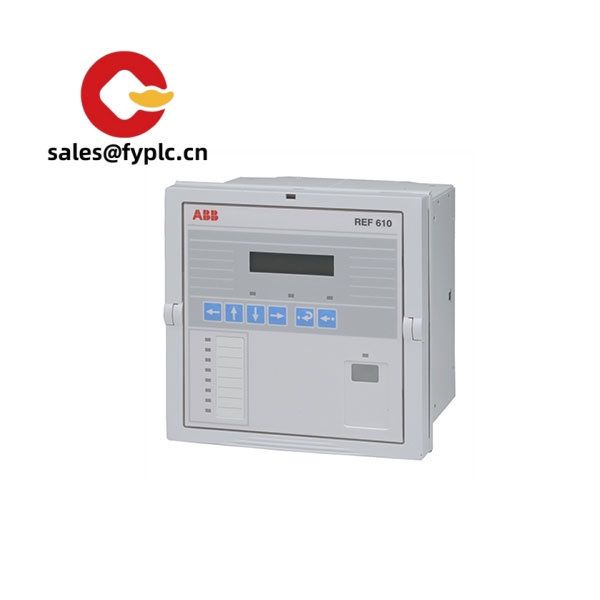
- ABB REF610 – Earlier-generation feeder protection; REF601 typically offers a more compact footprint and updated electronics.
- ABB REM601 – Motor protection relay in the same family; a suitable companion when feeders supply large MV motors.
- ABB REF630/620 – For complex schemes requiring advanced logic, bay control, or extensive GOOSE messaging.
- ABB RTXP 18 test switch – Useful accessory for safe secondary injection testing and isolation during maintenance.
- Current transformers (1 A / 5 A) – Match CT ratio and accuracy class to protection settings for best discrimination.
Installation & Maintenance
- Panel and environment – Mount on a rigid switchgear/panel door with sufficient ventilation. Avoid direct sun and condensation; keep ambient within the specified temperature range.
- Wiring practices – Route CT leads twisted and shielded where practical; ground shields at one end. Verify polarity (P1/P2, S1/S2). Use separate returns for trip and auxiliary circuits to reduce interference.
- Commissioning – Perform secondary injection to verify 50/51 and 50N/51N curves, pickup, and timing. Check trip circuit supervision and interlocks. Back up settings after validation.
- Protection coordination – In many cases, pairing IDMT curves with upstream/downstream devices gives cleaner selectivity; review cold-load pickup and inrush behavior.
- Routine maintenance – Dust the HMI and terminals periodically; tighten control wiring per torque specs. Re-verify settings annually or after network changes. Keep firmware up to date where applicable.
- Safety – Apply lockout/tagout. Short CT secondaries before disconnection. Confirm zero energy on trip circuits before service.
Quality & Certifications
- CE marked; designed to comply with relevant IEC protection standards for MV applications
- RoHS compliant materials; manufactured under ISO 9001 quality systems
- Many variants evaluated for use in North America (UL/cUL) – check exact order code for listing
- Manufacturer’s standard warranty is supported by our 365-day coverage
Quick user note: One thing I appreciate is how the REF601 keeps configuration straightforward. For a food processing client, swapping a legacy electromechanical relay to REF601 cut their feeder trip diagnosis time from hours to minutes because event logs immediately pointed to earth-leakage on a cable branch. It seems to be a small upgrade that pays back quickly in most cases.

Reviews
There are no reviews yet.