
Description
AUTOTECH SAC-RL100-M11T – Compact rotary encoder for reliable position/speed feedback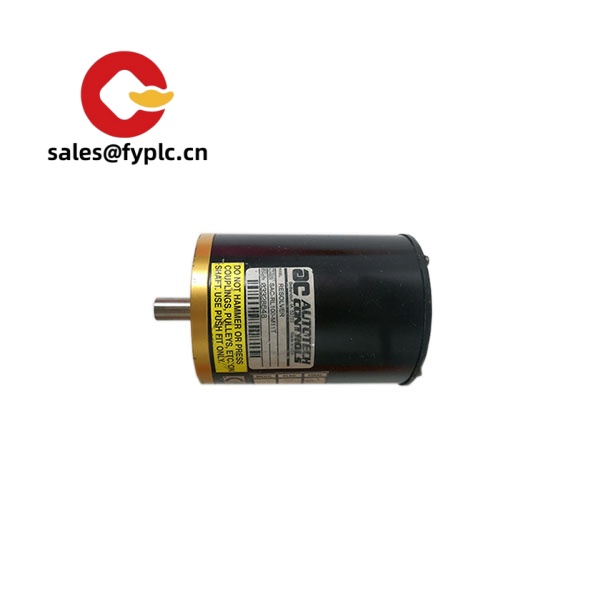
From my experience with AUTOTECH feedback devices, the SAC-RL100-M11T is a practical fit when you need steady, incremental position or speed feedback on a compact drive, feeder, or indexing station. The “RL100” designation typically indicates a 100-pulse-per-revolution setup, and “M11T” appears to denote an 11 mm through-bore style that’s easy to slip over a motor shaft. You might notice that it’s designed to play nicely with standard RS-422 quadrature inputs on PLC high-speed counters, motion controllers, and many general-purpose drives.
Our Order Placement Process and Guarantees
- Warranty: 365 days
- Delivery: 1 week if in stock; no more than 1 month at the latest
- Payment: 50% advance payment; full payment prior to delivery
- Express options: FedEx, UPS, DHL
Key Features
- 100 PPR incremental feedback – Suitable for general speed monitoring, basic positioning, and indexing tasks without overcomplicating the control logic.
- Through-bore mounting (≈11 mm) – The M11T style typically slides over a shaft and secures with a tether or clamp, saving space versus a flange mount.
- RS-422/TTL quadrature outputs – A/B/Z channels for direction and reference; easy to tie into PLC high-speed counters, motion cards, or digital drives.
- Wide supply range – Commonly 5–24 VDC, which helps when retrofitting mixed-voltage panels.
- Rugged industrial housing – Designed to handle typical plant vibration and dust; in many cases you’ll see IP-rated sealing for shop-floor use.
- Low maintenance – No brushes or potentiometer drift; once aligned, it tends to run for years with minimal attention.
Technical Specifications
| Brand / Model | AUTOTECH SAC-RL100-M11T |
| HS Code | 8543.70 (Electrical apparatus with individual functions, nesoi) |
| Power Requirements | Typically 5–24 VDC, < 150 mA (depends on output load) |
| Pulses per Revolution | 100 PPR (incremental, quadrature A/B with index Z) |
| Signal I/O Types | Differential RS-422 (A+, A–, B+, B–, Z+, Z–); push-pull or open-collector variants are common |
| Communication Interfaces | Quadrature pulse output to PLC/drive; no fieldbus required |
| Mounting / Installation | Through-bore (~11 mm) with anti-rotation tether or clamp; compact body for tight spaces |
| Operating Temperature | Typically -20 to +85 °C (application dependent) |
| Dimensions & Weight | Compact through-bore encoder form factor; consult drawing for exact OD and depth |
| Environmental | Industrial duty; sealing and IP rating typically suitable for dusty shop-floor environments |
Where it fits best
You’ll usually see this kind of encoder on small conveyors, feed rollers, compact servomotor shafts, or indexing dials where 100 PPR is enough resolution for drive speed feedback and basic position counts. One thing I appreciate is how forgiving RS-422 outputs are over longer cable runs when you need the panel several meters away.
A packaging OEM recently swapped in an AUTOTECH bore encoder similar to this model on a cartoner’s main shaft; it solved intermittent miscounts they had with an open-collector unit—simply because the differential signaling handled noise from nearby VFDs better.
Related or Supporting Products
- Shielded encoder cable – 2-pair or 3-pair twisted, 24–26 AWG, with drain wire; reduces noise on RS-422 signals.
- Flexible shaft couplings – If you adapt from an 11 mm bore to smaller shafts, zero-backlash beam or bellows couplings work well.
- Tether/anti-rotation brackets – Keeps the encoder body from rotating when using through-bore mounting.
- PLC high-speed counter modules – Any module that accepts differential A/B/Z inputs (5–24 VDC) will generally be compatible.
- Alternative PPR variants – Same SAC family encoders are often available in other PPR counts if you need finer position or smoother speed control.
Installation & Maintenance
- Mounting and alignment – Slide the encoder over the shaft (≈11 mm), secure with the clamp or tether. Avoid axial preload; keep shaft runout within typical encoder limits.
- Wiring – Use twisted, shielded pairs for A/A–, B/B–, Z/Z–. Ground the shield at one end only (usually the control panel) to minimize ground loops.
- Panel practices – Route encoder cabling away from VFD output leads. If proximity is unavoidable, use metal conduit and proper segregation.
- Power – Provide clean 5–24 VDC with adequate decoupling. A small inline filter or TVS protection helps in noisy environments.
- Routine checks – Inspect the tether/bracket fasteners and shaft fit every 3–6 months. Wipe dust from the housing; no internal lubrication needed.
- Calibration/firmware – Not applicable for incremental encoders; once installed and phased correctly, no calibration or firmware updates are required.
If you’re replacing an existing unit, match the PPR, output type (RS-422 vs. NPN/PNP), and supply voltage. Those three points usually make swaps painless.
Quality & Certifications
- CE and RoHS compliance in most configurations
- UL recognition often available for the encoder as an industrial component
- Manufacturer’s warranty: 12 months (365 days)
Note: Specifications above reflect the typical configuration for an AUTOTECH through-bore, 100 PPR incremental model. If you need confirmation on exact output type, supply range, or mechanical drawing for SAC-RL100-M11T, share your controller input requirements and we’ll cross-check the exact sub-variant before shipment.

Reviews
There are no reviews yet.