
Description
ENI OEM-12A – 13.56 MHz, ~1.2 kW RF Power Supply for Plasma Processing and Thin-Film Tools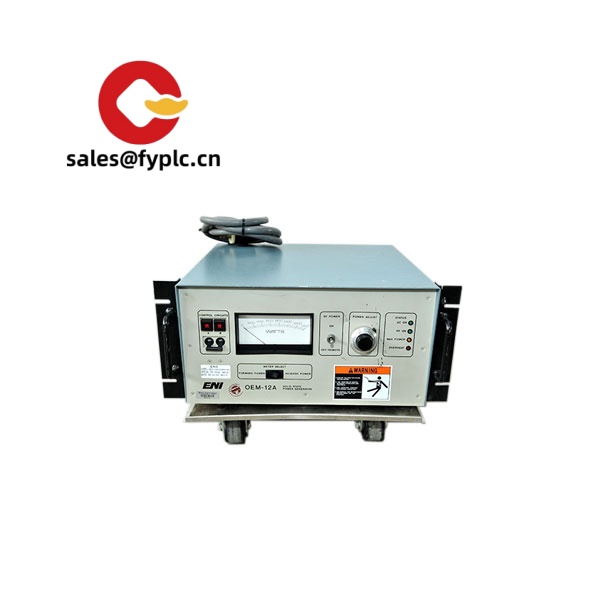
The ENI OEM-12A is a workhorse 13.56 MHz RF generator, typically delivering around 1.2 kW continuous power. It’s widely used on legacy and mid-generation PECVD, RIE, asher, and sputter platforms where stable forward power and quick arc recovery really matter. From my experience, the OEM-12A pairs well with automatic match networks on 13.56 MHz chambers and holds setpoint reliably even with changing plasma impedance.
You might notice that the unit’s analog remote interface makes integration straightforward—most fabs keep these running for years because maintenance is predictable and parts are still serviceable. One thing I appreciate is the fast power regulation: in many cases, it recovers cleanly after micro-arcs, which helps protect process consistency and target life.
Order Placement Process and Guarantees
- Warranty period: 365 days
- Delivery time: 1 week if in stock; no more than one month at the latest
- Payment method: 50% advance payment; full payment prior to delivery
- Express delivery options: FedEx, UPS, DHL
Key Features
- 13.56 MHz ISM-band output – Fixed-frequency source suited for plasma etch, deposition, and ashing lines.
- ~1.2 kW output class – Typically supports processes needing 0–1200 W with stable forward power control.
- Analog remote interface – 25-pin D-sub with 0–5 V setpoint and monitor signals for easy PLC/tool integration.
- Fast arc response – Appears to regulate and recover quickly, limiting reflected-power excursions.
- Built-in protection – Over-temperature, interlock, and reflected-power protection help reduce unplanned downtime.
- Serviceable design – Forced-air cooling and accessible modules make refurbishment and field service more practical.
- Rackmount form factor – 19-inch rack installation, typically 3U height, fits existing OEM bays in many tools.
Technical Specifications
| Brand / Model | ENI OEM-12A |
| HS Code | 8504.40 (Static converters – RF power supply) |
| Rated Frequency / Power | 13.56 MHz, ~1.2 kW (0–100% adjustable) |
| Power Requirements | 208–240 VAC, single-phase, 50/60 Hz; up to ~30 A at full load (typical) |
| Dimensions & Weight | Approx. 19″ W × 5.25″ H × 22–24″ D; ~23–25 kg (varies by revision) |
| Operating Temperature | +5 to +40 °C (typical lab/fab environment), non-condensing |
| Signal Input/Output Types | RF Output: 50 Ω, HN female high-power RF connector; Forward/Reflected power monitoring (analog). Control: Analog setpoint (0–5 V), interlock, remote on/off; status and fault signals (TTL/analog). |
| Communication Interfaces | 25-pin D-sub OEM remote (analog/TTL). No native RS-232/485 or Ethernet on this model. |
| Installation Method | 19″ rackmount, ~3U height; front-to-rear forced-air cooling; protective earth required. |
Related or Supporting Products
- ENI OEM-6A – 13.56 MHz, ~600 W. Smaller footprint and power class for low-power etch or strip modules.
- ENI OEM-12B – 13.56 MHz, ~1250 W. Later-generation update with similar interface and improved regulation in many cases.
- ENI OEM-25A – 13.56 MHz, ~2.5 kW. For higher-density plasmas or larger-area sputter cathodes.
- Automatic Match Network (13.56 MHz, 1.5 kW class) – Pairs with the OEM-12A to maintain low reflected power during recipe transitions.
- RF Coax Assemblies (50 Ω, HN or 7/16 DIN, RG393/LMR-400-class) – High-power jumpers between generator, matcher, and chamber.
- Directional Coupler / Inline Power Sensor (13.56 MHz) – Useful for independent forward/reflected verification and periodic calibration.
“We swapped an aging 1 kW source for the OEM-12A and saw smoother ignition on a polymer strip recipe. Power overshoot dropped noticeably,” a process engineer commented after a retrofit on a legacy asher tool.
Installation & Maintenance
- Cabinet and rack: Mount in a 19″ rack with at least 1U of clearance above/below when possible; support the rear due to depth and weight.
- Ventilation: Maintain clear front and rear airflow; avoid recirculating hot exhaust into the intake. Keep ambient within +5 to +40 °C.
- Power and grounding: Use a dedicated 208–240 VAC circuit sized for ~30 A; bond protective earth with a low-impedance strap.
- RF path: Keep coax runs short and well-terminated (50 Ω). Inspect HN connectors for carbon tracking; torque to spec to prevent arcing.
- Interlocks and control: Verify chamber and cooling interlocks before enabling RF. Check analog scaling (0–5 V = 0–100% power) during FAT/SAT.
- Routine care: Clean or replace intake filters and blow out dust quarterly in most fabs. Inspect fans and replace if noise or speed drifts.
- Calibration: Validate forward/reflected monitors with a calibrated coupler annually or after major service.
- Firmware/boards: This model relies on analog control; no user firmware updates. If control boards are revised, have them serviced by qualified technicians.
Quality & Certifications
- Certifications: Units in the field typically carry UL listing for US/Canada and many are CE-marked for EMC/LVD compliance (label-dependent).
- Environmental: Legacy ENI OEM-12A units are generally non-RoHS; consult your site policy for reuse of legacy equipment.
- Manufacturer Quality: Produced under established quality systems; later support through MKS/ENI service channels in many regions.
- Warranty: 365-day warranty on supplied unit as stated above.
If you’re upgrading a tool bay or replacing a failing generator, the ENI OEM-12A remains a practical choice: predictable analog control, solid 13.56 MHz stability, and straightforward service paths. Let me know the match network model and chamber load details, and I can verify connector type, harness pinout, and recommended coax lengths before shipment.

Reviews
There are no reviews yet.