
Description
EPRO PR6422/012-010 – Eddy-Current Proximity Probe for Shaft Vibration and Position Monitoring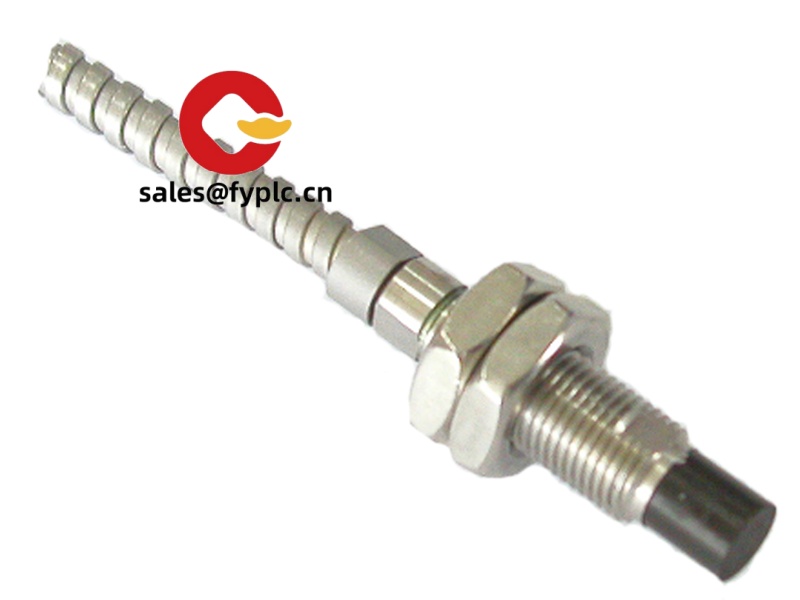
The EPRO PR6422/012-010 is part of the well-proven PR6422 proximity probe family used on turbines, compressors, and large rotating equipment for non-contact shaft vibration and axial position measurement. It’s typically paired with EPRO/B&K Vibro eddy-current drivers (such as CON011 / CON021 / CON041) to deliver both the DC gap signal and the dynamic AC vibration signal for API 670-style condition monitoring systems.
You might notice the code format “PR6422/012-010”; in many cases, the “/012” defines a specific mechanical variant and the “-010” indicates a cable/extension length option—worth double-checking against your nameplate or existing installation.
Company’s Order Placement Process and Guarantees
- Warranty: 365 days from shipment
- Delivery: 1 week if in stock; no more than one month at the latest
- Payment: 50% advance payment, balance due prior to delivery
- Express options: FedEx, UPS, DHL
Key Features
- Non-contact eddy-current sensing – Measures shaft displacement and vibration without touching the surface, minimizing wear and drift.
- Compatible with CON011 / CON021 / CON041 – The matched driver provides DC gap and AC dynamic outputs for monitoring and protection systems.
- Stable readings in harsh environments – From my experience, the PR6422 family holds calibration well in industrial temperature ranges and near high electromagnetics.
- API 670-style integration – Typically used in API 670 compliant chains, making it easier to retrofit into existing panels and racks.
- Robust cabling and shielding – Designed to reduce noise pickup on long runs, which is often the pain point on large machines.
- Variants for high temperature and hazardous areas – Ex-certified versions are available in the PR6422 family; check your exact suffix code to match the site zone classification.
Technical Specifications
| Brand / Model | EPRO PR6422/012-010 |
| HS Code | 9031.80 (Measuring or checking instruments; proximity/displacement sensor system) |
| Sensing Principle | Eddy-current, non-contact displacement (ferromagnetic target surfaces) |
| Application | Shaft radial vibration, axial position, and gap monitoring on turbomachinery and large rotating equipment |
| Power Requirements | Probe is passive; requires compatible driver (e.g., CON011/CON021), driver typically powered by -24 V DC |
| Signal Input/Output Types | With driver: DC gap voltage and AC dynamic vibration output (analog). Calibration depends on probe/driver/cable set. |
| Operating Temperature | Probe: typically -35 °C to +180 °C (standard PR6422 family variant; confirm exact code for high-temperature versions) |
| Communication Interfaces | Analog only via driver (no digital comms at the probe level) |
| Installation Method | Threaded probe with locknut in a rigid bracket; gap set with feeler gauge; shielded cable to driver; maintain correct standoff and target finish |
| System Compatibility | Works with EPRO/B&K Vibro CON011 / CON021 / CON041 drivers and common API 670 monitoring racks |
Related or Supporting Products
- EPRO CON011 – Classic eddy-current driver; provides DC gap and AC dynamic outputs. Good choice for general-purpose turbomachinery.
- EPRO CON021 – Driver with extended configuration options; typically used where specific range/linearity setups are needed.
- EPRO CON041 – Compact driver variant; often selected where panel space is tight.
- Matched Extension Cables – Order lengths to match your “-010” or other suffix; probe, cable, and driver are calibrated as a set for linearity and sensitivity.
- EPRO PR6423 – Similar probe family with different tip/measurement range options; typically chosen for larger gaps or different threads.
One thing I appreciate is how interchangeable the PR6422 seems to be with existing brackets on older skids. A maintenance engineer at a gas plant told us they swapped in PR6422/012-010 to replace legacy probes, kept their existing drivers, and immediately got steadier gap voltage with less noise—no major rework on the bracket.
Installation & Maintenance
- Mounting – Use a rigid, vibration-free bracket. Thread the probe and lock with the supplied nut. Set the initial gap using a feeler gauge per your machine’s spec (commonly around the mid-linear range of the probe/driver).
- Cabinet & Wiring – Install the driver in a ventilated cabinet (IP-rated as needed), separate signal and power wiring, and connect a single-point ground to minimize loops. Shielded cable routing away from VFD outputs helps reduce EMI.
- Calibration – Keep the probe, cable, and driver as a matched set. If any component is replaced, re-verify linearity and gap scale at the monitor. In most cases, a simple two-point check suffices on overhaul.
- Routine Checks – Inspect probe tip cleanliness and mounting tightness at each shutdown. Clean metallic debris from the tip and ensure the shaft surface finish hasn’t deteriorated.
- System Upkeep – If connected to an online monitoring system, apply any recommended firmware updates to the monitoring rack/software and keep channel notes aligned with the probe set serials.
- Safety – For hazardous locations, confirm your exact PR6422 variant code for Ex certification and install with approved barriers per site standards.
Quality & Certifications
- CE compliance for EMC and safety (family-level)
- RoHS-conform materials, typically used across the PR6422 family
- ATEX/IECEx variants available within the PR6422 range (check exact suffix)
- Manufacturer quality system commonly aligned with ISO 9001
- Standard manufacturer’s warranty applies; our sales warranty period is 365 days
From my experience, the lowest-risk path is to match the PR6422/012-010 probe with its originally specified extension cable length and a CON011 or CON021 driver calibrated as a set. If you share your existing driver code and cable length, we’ll cross-check the exact calibration so you don’t have to touch the monitor scaling.

Reviews
There are no reviews yet.