
Description
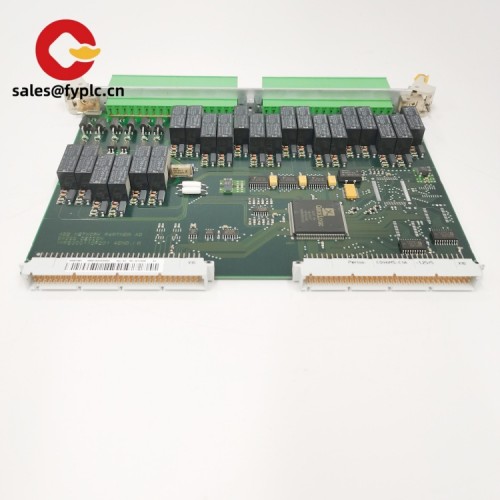
MITSUBISHI A1SJ61QBT11 – CC-Link Master/Local Network Module for MELSEC-A (A1S) PLCs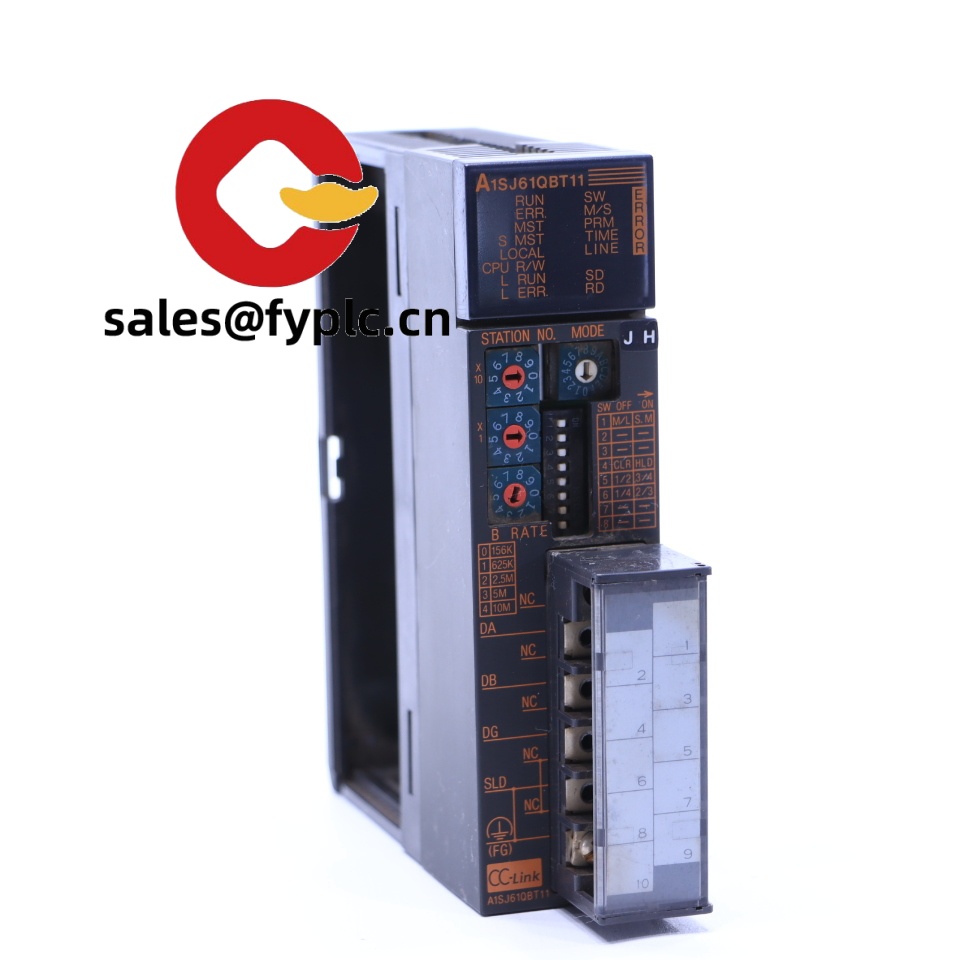
The MITSUBISHI A1SJ61QBT11 is a CC-Link fieldbus module designed for the MELSEC-A (A1S) series. It works as a Master or Local station on a CC-Link network, making it a straightforward way to connect distributed I/O and devices across a production line. From my experience, teams choose this module when they need robust, deterministic I/O networking with simple setup and solid diagnostics on legacy A-series platforms.
Company’s Order Placement Process and Guarantees
- Warranty: 365 days
- Delivery time: typically 1 week if in stock; no more than one month at the latest
- Payment terms: 50% advance payment, full payment before delivery
- Express options: FedEx, UPS, DHL
- Each unit is function-tested before dispatch; packaging is industrial-grade with anti-static protection.
Key Features
- CC-Link Master/Local station – Configure as a Master to control the network or as a Local station to join an existing line.
- Selectable baud rates (typical CC-Link V1) – 156 kbps, 625 kbps, 2.5 Mbps, 5 Mbps, 10 Mbps for flexible cable distance and throughput trade-offs.
- Up to 64 stations – Common CC-Link topology for larger distributed I/O systems in packaging, machining, and material handling.
- Simple wiring – 5-point terminal block (DA, DB, DG, SLD, FG) with shielded twisted-pair CC-Link cable; termination at both ends.
- Status diagnostics – Front LEDs for RUN/L.RUN/L.ERR and data activity help speed up troubleshooting on the floor.
- Seamless A1S rack integration – Draws 5 V from the backplane; addresses and station settings are typically via front rotary switches.
- Deterministic I/O mapping – Remote I/O points and link registers map directly into PLC memory, which tends to simplify ladder logic.
Technical Specifications
| Brand / Model | MITSUBISHI A1SJ61QBT11 |
| Main Function | CC-Link network module (Master or Local station) for MELSEC-A (A1S) PLCs |
| HS Code | 8537.10 (Boards, panels, consoles for electric control) |
| Power Requirements | Supplied from A1S backplane (5 VDC bus) |
| Operating Temperature | 0 to 55°C (typical for A-series modules) |
| Signal I/O Types | CC-Link fieldbus (remote I/O and link registers) |
| Communication Interface | CC-Link V1, 1 network port via 5-pin terminal (DA/DB/DG/SLD/FG) |
| Baud Rates | 156 kbps / 625 kbps / 2.5 Mbps / 5 Mbps / 10 Mbps |
| Max Stations (typical) | Up to 64 per network (subject to topology and device occupancy) |
| Installation Method | Plug-in module for A1S base unit; DIN-rail via base |
Application Fields
You’ll typically see the A1SJ61QBT11 used in legacy lines that are still running strong: bottling and packaging, printing, machine tools, automotive cells, and warehouse conveyors. It’s a practical choice when you want to network remote I/O blocks (digital and analog), inverters, and simple devices over long distances with deterministic updates. One thing I appreciate is the way CC-Link keeps cycle times predictable even as you add more stations.
Advantages & Value
- Reliability – CC-Link is time-tested in harsh environments; fewer surprises during commissioning.
- Compatibility – Fits directly in A1S racks and communicates with widespread CC-Link remote I/O like AJ65SBTB1 series.
- Lower retrofit risk – Keeps existing MELSEC-A assets productive without an immediate platform migration.
- Maintenance-friendly – Clear LED indicators and simple termination reduce downtime when something goes off.
- Procurement practicality – Stable lead time, global carriers, and a one-year warranty make planning easier for shutdown windows.
Installation & Maintenance
- Cabinet and environment: Mount the module in an A1S base within an enclosed cabinet, 0–55°C, 5–95% RH non-condensing. Provide ventilation; avoid conductive dust and vibration.
- Wiring (CC-Link): Use shielded twisted pair CC-Link cable with ~110 Ω characteristic impedance. Terminate both ends (110 Ω, 1/2 W typical). Ground shield at one point to prevent loops.
- Topology: Trunk-line with branch drops kept as short as practical. At higher baud rates (e.g., 10 Mbps) keep segment lengths shorter; longer runs are fine at 156 kbps.
- Addressing: Set station number and mode (Master/Local) via front rotary switches/dips. Verify in PLC parameters before first scan.
- Routine checks: Inspect terminal tightness quarterly, clean dust with dry air, and review error LED history. Firmware updates are rare on A-series, but keep project backups aligned with the installed hardware.
- Safety: Power down the rack before inserting/removing the module. Confirm shield continuity and correct polarity (DA/DB) to avoid bus errors.
Quality & Certifications
- CE and UL/cUL compliance for industrial control equipment
- RoHS compliant (varies by manufacturing lot; typically yes on later lots)
- Manufacturer quality system aligned to ISO standards
- 365-day warranty from our side; coverage includes replacement or repair
Supporting Components (Typical Pairings)
- MITSUBISHI A1S68B / A1S38B – A-series base units (choose slot count to fit your system size).
- MITSUBISHI A1S62P / A1S61PN – Power supply modules for the A1S rack.
- MITSUBISHI A1SCPU (various) – MELSEC-A CPUs compatible with the A1S platform.
- MITSUBISHI AJ65SBTB1-16D / AJ65SBTB1-32DT – CC-Link remote I/O blocks (sink/source options) for distributed digital I/O.
- CC-Link dedicated cable and terminators – Shielded twisted pair with matching terminators for stable communication.
A maintenance lead at a beverage plant told us they swapped several panel-mounted I/O cards for AJ65SBTB1 blocks on CC-Link with the A1SJ61QBT11 as Master; panel wiring dropped a lot and fault tracing got less painful.
Why teams pick this module
You might notice that when you’re maintaining a mature A-series line, simplicity beats novelty. The A1SJ61QBT11 keeps the control architecture lean, parts are still serviceable, and the learning curve for technicians is gentle. In many cases, that translates to fewer weekend callouts and a predictable spare strategy.

Reviews
There are no reviews yet.