
Description
National Instruments NI PCI-4461 – 24-bit Dynamic Signal Acquisition & Generation for Sound and Vibration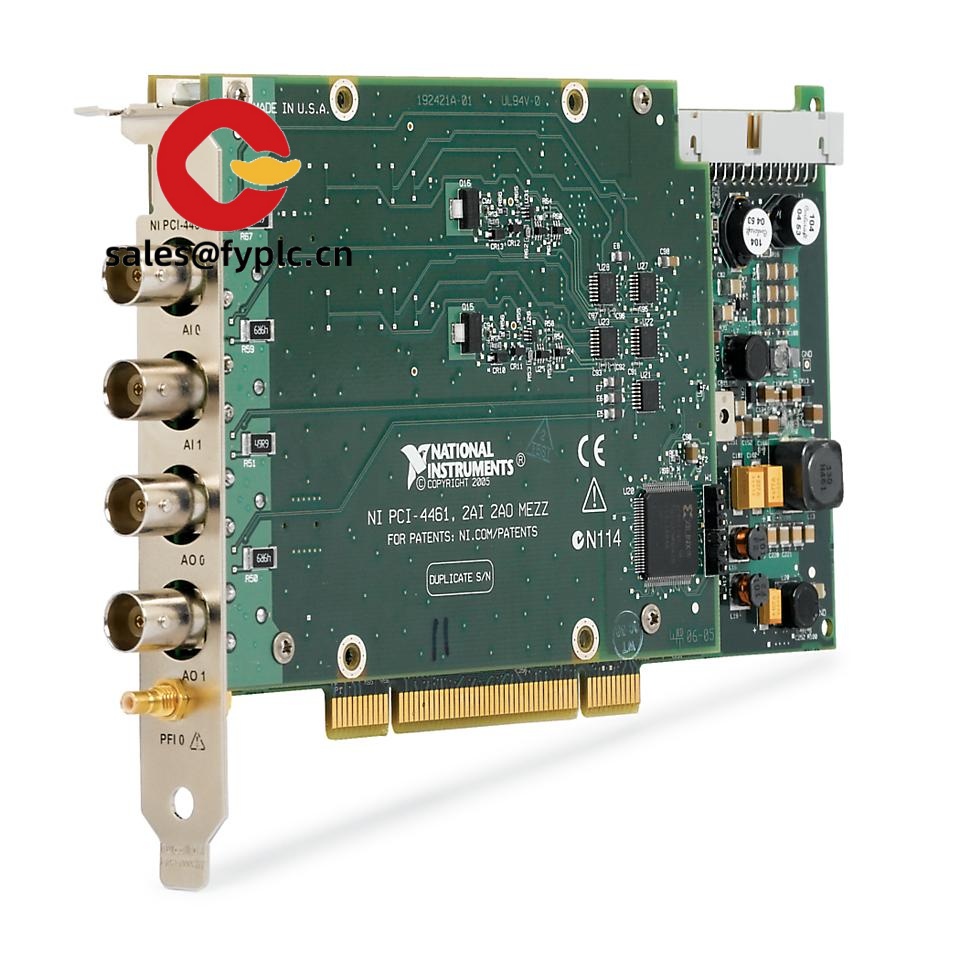
The NI PCI-4461 is a dynamic signal acquisition and generation board designed for precision audio, acoustics, and vibration work inside a standard desktop PC. You get two high-resolution analog input channels and two analog output channels, all 24-bit with selectable anti-aliasing and sample rates up to 204.8 kS/s. One thing I appreciate is how it pairs clean IEPE sensor power with low-noise converters—so you can plug in microphones and accelerometers directly and start characterizing noise, resonance, or transfer functions without a pile of external gear.
From my experience, this card shines in tasks like modal analysis, speaker testing, rotating machinery diagnostics, and closed-loop stimulus/response measurements. You might notice that it behaves more like a compact analyzer than a generic DAQ—filters follow the sample rate, the inputs are truly simultaneous, and the outputs are equally precise, making swept-sine or multi-tone testing straightforward.
Order Placement Process and Guarantees
- Warranty: 365 days
- Delivery time: Typically 1 week for in-stock items; no more than one month at the latest
- Payment terms: 50% advance payment; full payment prior to delivery
- Express options: FedEx, UPS, DHL
Key Features
- 24‑bit, simultaneous AI and AO – Two analog inputs and two analog outputs with 24‑bit converters for wide dynamic range in acoustic and vibration tests.
- 204.8 kS/s per channel – High sample rates with tracking anti‑aliasing filters; ideal for spectra up to the tens of kHz range.
- IEPE sensor support – Integrated constant‑current excitation for accelerometers and microphones, so no separate conditioners in most cases.
- AC/DC coupling and flexible ranges – Capture small signals on large offsets or run clean DC measurements; ranges typically up to ±10 V.
- Low noise and high linearity – Designed as a DSA-class board; it typically delivers the kind of noise floor you expect from a bench analyzer.
- Hardware timing and triggering – Deterministic, synchronized stimulus/response, with PFI/RTSI-based triggering and multi-device sync options.
- Software ecosystem – Works with NI‑DAQmx, LabVIEW, and Sound & Vibration toolkits; commonly used with Python and MATLAB via drivers.
- Front-panel BNC connectivity – Standard BNC I/O simplifies lab wiring for sensors and reference instruments.
Technical Specifications
| Brand / Model | National Instruments NI PCI-4461 |
| HS Code | 9030.89 (Measuring or checking instruments; other) |
| Analog Inputs | 2 channels, 24‑bit Σ‑Δ, simultaneous; up to 204.8 kS/s/ch; AC/DC coupling; selectable ranges up to ±10 V; IEPE excitation per channel |
| Analog Outputs | 2 channels, 24‑bit; up to 204.8 kS/s/ch; ±10 V nominal output range |
| Signal I/O Connectors | Front-panel BNC for AI/AO; PFI/trigger available for sync and start/stop |
| Communication Interface | PCI (plug-in board); supports RTSI for multi-device synchronization |
| Power Requirements | Powered from the PCI bus; no external supply required |
| Installation Method | Internal PCI slot, single-slot, half-length board |
| Operating Temperature | 0 °C to 50 °C (typical for NI PCI plug-in modules) |
| Dimensions & Weight | Single PCI slot footprint; approx. < 0.5 kg |
| Software Support | NI‑DAQmx, LabVIEW, LabWindows/CVI; commonly used with MATLAB/Python via NI drivers |
Related or Supporting Products
- NI PCIe-4461 – PCI Express version with similar I/O; preferable for modern PCs that lack legacy PCI slots.
- NI PXI-4461 – PXI modular form factor for chassis-based systems and tighter multi-module sync.
- NI PCI-4462 – 4 AI channels (24‑bit DSA) without analog outputs; good when you need more input channels only.
- NI PCI-4472 – 8 AI DSA with IEPE, no AO; popular for multi-point vibration monitoring.
- NI 9234 (cDAQ) – 4‑ch IEPE module; portable alternative when you prefer a USB/Ethernet chassis.
- IEPE sensors & BNC accessories – Typical pairs include ICP/IEPE accelerometers or measurement microphones with 50 Ω BNC coax leads.
Installation & Maintenance
- PC and slot – Install in a grounded desktop with a free, full‑height PCI slot. Power down and discharge static before handling the board.
- Ventilation – Maintain clear airflow across the PCI area; avoid packed enclosures or blocked fans, especially during high‑duty sweeps.
- Wiring – Use quality BNC coax; keep sensor and output leads away from mains lines. For IEPE sensors, verify excitation current and coupling mode (AC/DC) in software.
- Grounding & noise – Minimize ground loops by referencing all instruments to a common ground. Shorter cables help reduce pickup in most cases.
- Software/driver – Install NI‑DAQmx and, if needed, LabVIEW Sound & Vibration Toolkit. Firmware and driver updates typically improve stability and device support.
- Calibration – Annual calibration is usually recommended for compliance work. Many teams pair it with a microphone or accelerometer calibration check.
- Routine care – Keep the bracket and BNC jacks clean; gently dust the PC interior every few months to maintain cooling.
Customer feedback: “We replaced a benchtop analyzer with the PCI‑4461 and cut our swept‑sine test time by ~30%. The built‑in IEPE saved us a conditioner per station.” – Automotive acoustics lab, EU
Quality & Certifications
- Certifications – CE and RoHS compliant; FCC Class A EMC; WEEE applicable. UL/CB on host PC as applicable.
- Manufacturer standards – Built to NI’s typical DSA performance criteria with factory verification; traceable calibration available on request.
- Warranty – 365-day warranty from us; manufacturer’s standard policy is typically 1 year.
If you’re upgrading an older PCI workstation, the NI PCI-4461 remains a dependable choice. For new builds, it often makes sense to consider the PCIe or PXI variants for longevity, but for labs wanting a clean AI/AO DSA board in an existing PC, this model still hits a very practical sweet spot.

Reviews
There are no reviews yet.