
Description
Schneider Electric TM3TI4G – 4‑Channel Thermocouple Input Module for Modicon M221/M241/M251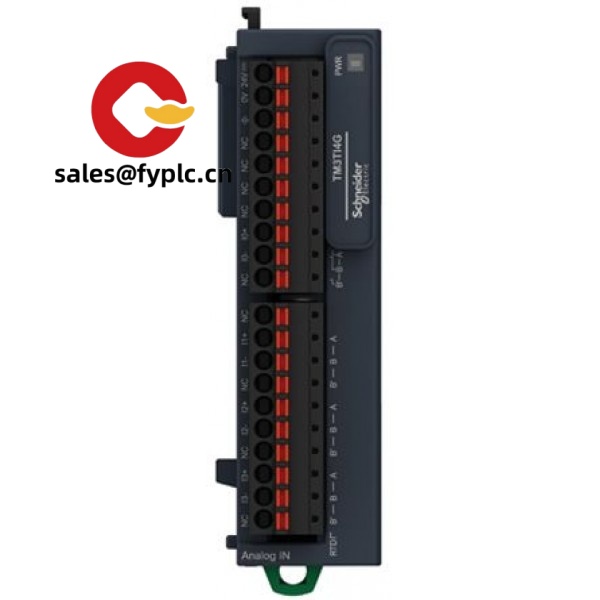
The Schneider Electric TM3TI4G expands your Modicon controller with four reliable thermocouple inputs, making it a straightforward choice for compact machines that need stable temperature feedback. From my experience, it slots into OEM panels neatly and just works—especially when you don’t want the overhead of a separate temperature transmitter. You might notice that the “G” variant is favored in plants with grounded thermocouples and tougher EMC conditions.
Company’s Order Placement Process and Guarantees
- Warranty period: 365 days
- Delivery: 1 week for in‑stock items; no more than one month at the latest
- Payment: 50% advance payment; full payment prior to delivery
- Express options: FedEx, UPS, DHL
Key Features
- 4 thermocouple inputs – Supports common types (J, K, T, E, R, S, B, N) for broad application coverage.
- “G” variant compatibility – Typically better tolerance for grounded thermocouples and electrical noise found in industrial cabinets.
- Built‑in cold junction compensation (CJC) – Stable readings without external CJC blocks in most cases.
- 16‑bit measurement resolution – Fine granularity for heating, packaging, and light process tasks.
- Open‑circuit detection & status LEDs – Faster troubleshooting when a probe breaks or wiring loosens.
- TM3 snap‑on expansion – Mounts on DIN rail and attaches to the right side of Modicon M221/M241/M251 controllers via the local TM3 bus.
- Configured in the PLC software – Set channel types and scaling through EcoStruxure Machine Expert – Basic (formerly SoMachine Basic).
Technical Specifications
| Brand / Model | Schneider Electric TM3TI4G |
| HS Code | 8537.10 (Programmable controller equipment) |
| Power Requirements | 24 VDC supplied via TM3 local bus from the host controller; typical module consumption < 100 mA |
| Signal Input/Output Types | 4x thermocouple inputs (J, K, T, E, R, S, B, N), built‑in CJC, open‑circuit detection, 16‑bit resolution |
| Communication Interfaces | TM3 expansion bus (local); no external fieldbus port on the module |
| Isolation | Galvanic isolation to the TM3 bus; typically suitable for grounded thermocouples |
| Operating Temperature | 0 to +55 °C (panel‑mounted), non‑condensing humidity |
| Dimensions & Weight | Approx. 27.6 (W) × 90 (H) × 70 (D) mm; ~0.12 kg |
| Installation Method | DIN rail (EN 60715); attaches to the right side of Modicon M221/M241/M251 via TM3 bus connector; removable terminal block |
| Compatible Controllers | Modicon M221, M241, M251 (TM3 local expansion) |
A packaging OEM told us they moved from external temperature transmitters to TM3TI4G on a new cartoner and shaved hours off commissioning—less wiring, and faults were simpler to diagnose because the PLC saw probe breaks instantly.
Related or Supporting Products
- Schneider Electric TM3TI2 – 2‑channel thermocouple input when panel width is tight or you only need a couple of probes.
- Schneider Electric TM3TR4 – 4‑channel RTD input (e.g., Pt100/Pt1000); better for long runs or where RTDs are standard.
- Schneider Electric TM3AI2 – 2‑channel analog voltage/current input for general process signals (0–10 V, 4–20 mA).
- Schneider Electric TM3AQ2 – 2‑channel analog output to drive valves, speed references, or temperature setpoints.
Installation & Maintenance
- Panel environment – Install in a ventilated control cabinet; keep within 0–55 °C and avoid condensation. Leave clearance for heat dissipation and wiring bends.
- DIN rail and bus – Mount the module on EN 60715 DIN rail and snap it to the right of the controller. Ensure the TM3 bus connector and end cover are properly seated.
- Wiring practices – Use thermocouple‑grade cable and matching connectors. Route away from VFD outputs, contactors, and high‑current runs. Shielded cable with single‑point grounding typically gives the cleanest results.
- CJC & accuracy – Keep terminal blocks out of hot spots; consistent cabinet temperature helps the CJC perform optimally.
- Routine checks – Periodically verify channel assignment/type in the PLC, inspect terminal tightness, and validate readings against a reference probe if your process is critical.
- Firmware & backups – Manage updates through the PLC engineering tool. Save configuration/recipes so a module swap can be done in minutes.
- Safety – De‑energize the control panel before servicing. Confirm correct polarity on thermocouples; reversing leads will invert readings.
Quality & Certifications
- CE marked; typically cULus Listed for North America
- RoHS compliant; manufactured under Schneider Electric’s quality system
- Manufacturer’s standard warranty applies; our coverage provides 365 days from delivery

Reviews
There are no reviews yet.